

Inside the Mini Book Assembly Line
Read the Chapter That Got Removed in Editing + Updates

Hey Revenue Writers,
It’s been awhile since I did an update post and wanted to catch you up on all the going ons.
While Christmas and Holidays have given me plenty of traveling and things to do with the family, the Mini Book side of my life keeps growing. (not to mention my company IA Path, my main business)
Category Pirates Update
I’ve been working closely with Category Pirates 🏴☠️ helping them with processes for their creation of their major releases. (anything bigger than a Mini Book)
They are looking to launch a major release a quarter… which is a freaking assembly line and so I’m learning a lot about working with a team to create a book. Even learning things like how to make high end books with gold foil, bookmarks, etc. and the challenges that come with that.
The team is about to launch a new book that was totally different than anything I’ve ever done… watch out for it, it’ll be epic.
Strike Marketing Summit
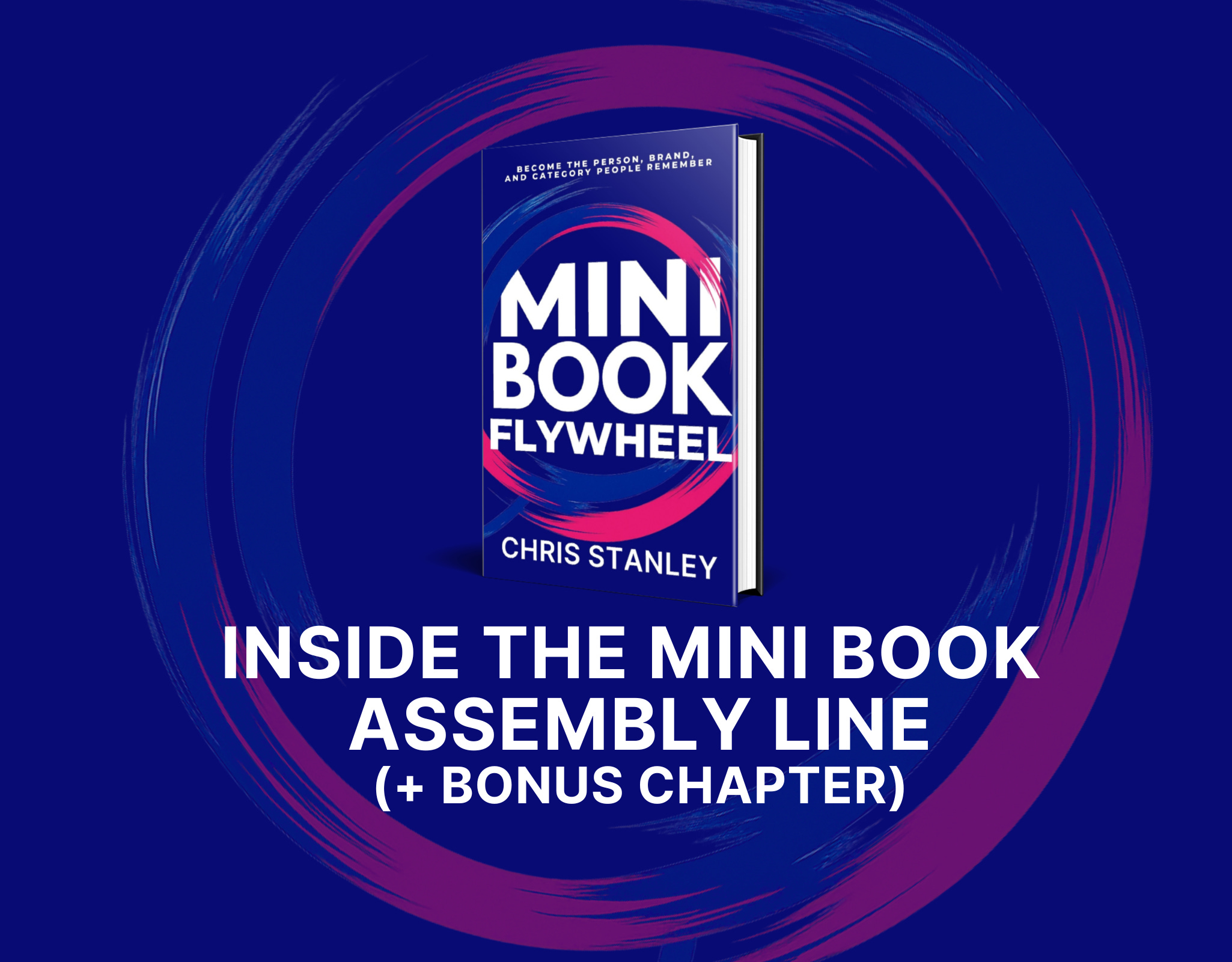
Two weeks back I spoke at Strike Marketing Summit and had a blast with Fernando Labastida of Startup Strike giving a talk about the core of my upcoming book Mini Book Flywheel.
It was the first time I’ve spoken publicly on the topic.
I was slightly nervous because I was in the middle of a huge developmental edit with the book and hadn’t landed the plane so to speak.
Developmental Edit
In case you are like “What is a developmental edit?” I’ll explain.
Mini Book Flywheel is a about a new mindset and discipline and I tackled it with my signature “W’s" Outline Method”.
I answered,
What
When
Where
Why
Who
How
about flywheels and those were my chapters.
But… because I was flushing out my own thoughts each chapter had significant overlap. So I hired an editor to help me make heads or tails of it and make it cohesive throughout without too much redundancy.
While he didn’t suggest I delete an entire chapter when we got done I read through the book and the final chapter was redundant and I selected it all and hit delete. (don’t worry it wasn’t the “How to Build a Flywheel” and you can read it below!)
Subtitle Struggles
I also have been struggling with the subtitle.
Originally it was “Become the Person, Brand and Category People Remember”
Then I changed it to “How to Use Category Design and a Writing to Become Unforgettable”
But… I looked back at my original subtitle and fell in love with it all over again.
The original heart of the book was to teach people how to use Mini Books to create a brand using Mini Books. I wanted people to know immediately that this works for Brands, coaches (individuals), and category designers.
So I’m back to the original subtitle. LOL If any of you has ideas, let me know.
I’m still spinning on versions like,
”Using Writing and Category Design to Become Unforgettable”
But for now… it is back to the original.
The Deleted Chapter
So today I thought I’d share my deleted chapter. It cut nearly 2k words out of the final manuscript, which was great, because I was over my Mini Book Limit of 15k and nearly at 18k words!
Now you may notice some em dashes, no that isn’t AI writing. That is my editor who is a traditional editor that actually uses em dashes in writing to fix my long run on thoughts.
I often remove them (much to his annoyance I’m sure) just because it feels so unlike me, but you will notice some still.
Now, there is nothing wrong with this chapter as a stand alone, but taken in content and position in the book its repetitive.
So this is a great one chapter preview of the upcoming book. (which the other chapters are WAY better in my opinion than this one which is why I cut it)
Enjoy
7 Layers of a Brand Flywheel
Now, let’s look at what a flywheel is made up of.
Creating a memorable brand takes more than shouting your name.
My company, IA Path, taught me this the hard way. What started as a training program turned into a category-defining mentorship model that changed how people got started in adjusting. And along the way, I realized something important: it wasn’t a logo or a tagline or a color scheme that made me memorable, it was the layers of my flywheel, and every one of those layers began forming the moment I wrote my first Mini Book.
As I look back on the flywheel I built, there are seven identifiable layers that keep it spinning so that it powers my business:
Category
Point of View
Language
Frameworks
Products
Projects
Testimonials
Everything I’ve learned about building a memorable brand began the moment I wrote The Independent Adjuster’s Playbook. That Mini Book became the center of gravity my entire flywheel spun around. Writing it didn’t just organize what I believed, it quietly created a category.
A Mini Book is the clearest and fastest way to create a category, because writing one forces you to define all seven layers of your flywheel in one place: Your category takes shape because you must name what you’re doing. Your point of view sharpens because you must argue for it. Your language tightens because the book demands clarity. Your frameworks emerge because you must explain how things work. Your products reveal themselves because readers want the next step. Your projects align because the book attracts the right people. Your testimonials gather because the book creates transformation.
In other words: the Mini Book doesn’t live inside the flywheel, it builds the flywheel.
In this chapter, I’ll show you how each layer formed inside the pages of my Mini Book, how those layers became IA Path’s brand, and how your own Mini Book will do the same for you. Everything I have learned about building a business comes from my own experience, so I rely heavily on looking back and analyzing what happened.
You’ll see IA Path used extensively as an example, and I confirm the theory with other companies.
Category
At first, IA Path was just another training company.
I taught people how to write auto damage claims and kept getting compared on price, days, and delivery. Every call turned into “Why should I pick you instead of them?” and I was trapped in their frame.
The moment I wrote my Mini Book, the frame shifted.
Putting my beliefs into a book made me realize I wasn’t selling training at all, I was building a mentorship company, a company that offered a way to get the experience requirements waived.
That shift changed everything.
Over time, “virtual mentorship for independent adjusters” (my category) grew into the EXP Free Career Path for Independent Adjusters. Training, certification, work placement, and mentorship stacked together into one system. And the Mini Book was the first place that system lived in writing.
Suddenly, no one could compare us to a three-day training course.
We weren’t in their lane anymore. In fact we created a whole new track!
When you define the category, you define the rules.
Airbnb didn’t fight hotels. They created home-sharing.
Uber didn’t try to out-taxi taxis. They created ridesharing.
Once you flip the category, the comparison game is over.
And flipping the category is how you finally stop explaining and start leading.
But your category is defined by your point of view.
Point of View (POV)
A brand is nothing if you don’t have a compelling POV.
For us, the belief was clear: independent adjusters should start without waiting years for experience.
The Mini Book forced me to put that belief on the page, clearly, simply, and boldly. That clarity became the compass for everything we built.
That simple sentence had three anchors,
the person (independent adjusters),
the problem (experience requirements),
the solution (a way to get work without experience, i.e., an EXP Free Career Path).
If it didn’t serve that belief, we didn’t do it.
POV also works as a filter.
Some people hated the idea of starting in auto claims. They wanted homeruns from catastrophic property opportunities, not base hits that auto provided. That pushback told me our POV was sharp enough to divide. The right people leaned in harder, and that’s all that mattered.
Chipotle’s belief was “Fast food can be real.”
Oatly’s was “Plants can do it better than cows.”
Beliefs that polarize are the ones that spread.
A POV is the message people remember when you aren’t in the room and the Mini Book is where that message becomes something they can quote.
Language
If you don’t tell the market what you are and what you do, the market will decide on its own.
There are three key things you need to language as you build your flywheel:
The category name — your unique solution
The problem — what your category solves
The villain — the thing that causes the problem
My Mini Book was where these words locked into place.
Experience requirements were the problem, but I named the enemy The Adjuster Lottery, the wait-and-hope game of sitting around for catastrophe work. We flipped it with Claim Your Life, a rallying cry to start our way and take control. Terms like EXP Free (category) and Virtual Mentorship became shorthand for a path no one had named before.
Once the words landed, they started spreading without us.
Dollar Shave Club went after Big Razor. Liquid Death went after Big Plastic. Play Bigger went after the Existing Market Trap.
Language sticks when you name the enemy and the escape. And when the market carries your words, you’ve won.
Frameworks
People don’t remember mission statements, but they do remember treasure maps.
My first Mini Book laid out the 7 Steps to Getting Work Without Experience, and once those steps were on paper, they became a framework the market could follow.
Clarity turned a messy idea into a movement anyone could join. Suddenly, we weren’t just teaching. We were charting the way.
Frameworks transfer authority and results.
Competitors sent beginners to us because our map was the clearest. Students trusted us because the steps felt doable. IA firms trusted us because the steps produced consistent results.
The clearer your map, the more people assume you know the territory and nothing clarifies a map like the discipline of writing it into a Mini Book.
If you want to be remembered, you need a signature framework and to document it in a Mini Book.
Products
Products are vehicles of transformation.
The product that made IA Path the default wasn’t just our book, it was the product the book pointed to. The EXP Free Career Path took the promise of the Mini Book and turned it into a complete system: training, certification, 40+ firm introductions, and a year of mentorship.
Students became working adjusters. Firms finally had talent they could count on. The product spoke louder than we ever could.
That flagship anchored the category.
Once your product becomes the reference point, you stop being an option and start being the expectation.
Books build belief. Products deliver the transformation that reinforces it.
Projects / Initiatives
What you build outside of profit shows what you believe.
Many of IA Path’s early projects — including the virtual job fair — existed because people read the Mini Book and asked for more. Three nights. Thirty adjusters. Fifteen firms. We broke even, but dozens landed work. Years later, alumni still ask if we’ll ever do another.
That project told people what we cared about. And projects also polarize.
Some competitors mocked us for charging $97 for a job fair. Participants said it launched their career.
Liquid Death didn’t need to create stunts to sell water, but the stunts clarified the belief behind the product.
Projects show your POV in motion.
Testimonials / Word of Mouth
Your brand is what people say when you’re not around.
“The Auto Guy” was the first nickname I didn’t give myself. It came from AdjusterTV, then spread through email and LinkedIn. It stuck because I talked about auto for years — and because readers of my Mini Book started getting results.
Over time, the trust timeline shrank from years to days.
Testimonials tightened the belief flywheel.
Screenshots, referrals, videos, proof stacked on proof. Each new story pulled the next person closer. When people can tell your story better than you, because it’s now their story, you’ve hit escape velocity.
Word of mouth always outperforms marketing. Reputation becomes the repetition you don’t control.
The Layers in Orbit
Each layer feeds the others. Category sets the stage. POV sets the belief. Language makes it repeatable. Frameworks make it teachable. Products make it tangible. Projects make your POV visible. Testimonials make you believable.
Spin them together and you don’t get a funnel, you get a flywheel. And your Mini Book is what gives that flywheel its first push.
Hope you enjoyed, lots more to come, back to editing and prepping for launching the entire book for you all.
Coach Chris
Great summary! I can relate this to my mini book that I'm working on now. I used your Ws and H method to outline it. Working on designing the cover now. Having a great editor is an essential ally!