

Mini Book Build Sheet
Every Step to Create Your First or Next Mini Book

Hey Revenue Writers,
Welcome to Revenue Writer Wednesday, where I roll out something special for paying members.
Most people reach out wondering, “What do I do next?”
They tell me where they’re at and most of the time are COMPLETELY overwhelmed by the entire process of writing and publishing a book, even if it’s “only” a Mini Book.
Here’s the thing: I get it.
I’ve written and published 31+ books. I’ve been building my own system for how I go from idea to bookstore for 9 years. And even I still feel that overwhelm creeping in when I start a new project.
I’ve written lists. Dozens of them. I’ve created Trello Boards that looked beautiful but never got used. I’ve built Notion boards that became digital graveyards. I even wrote entire books about different steps in the process.
But I’d never FULLY documented the entire step-by-step process as thoroughly as I wanted. Not in one place. Not in a way that was simple enough to actually follow when you’re in the middle of the chaos.
Then Category Pirates 🏴☠️ called.
Six months ago, I started working with them on their book production system. Category Pirates are legendary in the world of category design. Christopher Lochhead, Eddie Yoon, Nicolas Cole, Katrina Kirsch—these people have built their entire careers around helping companies and creators design categories that dominate markets.
They had a small team of brilliant people working together to produce books. World-class thinkers. Skilled writers. People who understood category design better than almost anyone on the planet.
But here’s the problem they kept running into:
Eddie and Lochhead would finish their first draft. Then everything went dark.
Eddie had no idea where the project was at. He couldn’t tell you if they were in editing, formatting, or stuck waiting on a cover designer. He had no clue when they’d actually be able to publish.
When he wanted to make a change—swap a chapter, update the subtitle, revise the back cover copy—he had no way to know what that decision would cascade into. Would it push the launch back a week? Two weeks? Would it affect the audiobook production? The print version?
The information existed somewhere. Buried in email threads. Scattered across different people’s inboxes. But there was no single source of truth.
Sound familiar?
Here’s what makes this wild: these are some of the smartest business minds on the planet. They’ve helped Fortune 500 companies design billion-dollar categories. They know systems. They know process.
But even they were drowning in the chaos of book production without a clear roadmap.
Eddie is a spreadsheet guy. He thinks in rows and columns. Give him data, and he can make decisions. But without a system to show him where things stood, he was flying blind.
So I took everything I’d learned from publishing 31+ books, all those lists and boards and systems I’d built over 9 years, and I transferred it all into one Excel spreadsheet.
Then I started working with their team. Adding tasks they needed. Removing steps that didn’t apply. Tweaking the order. Clarifying who owned what. Testing it against real deadlines.
Week after week, I refined it based on what actually worked in the real world with a real team producing real books.
My only goal was to make it STUPID simple.
Status → Due Date → Task → Details/Notes → Files/Links
That’s it. Five columns. No complexity. No philosophy.
Now Eddie could open the sheet and know exactly where any project stood in 10 seconds. When he wanted to make a change, we could update the due dates and see immediately how it affected the timeline. No more guessing. No more getting lost in email threads trying to piece together what happened three weeks ago.
Open the sheet. Look at the next “Not Started” task. Do it. Update the status. Move on.
The system worked.
Books that used to take months of coordination started moving faster. People stopped getting lost in email chains. Eddie could look at the sheet and know instantly if they were on track to hit their publish date or if something was bottlenecked.
When they decided to change something, they could see the ripple effect in real time.
That’s when it hit me: If this system worked for Category Pirates with a team, imagine what it could do for solo writers drowning in overwhelm.
So I went back to that spreadsheet and expanded it.
I rebuilt it for all of us who don’t have a team. Who are doing everything ourselves. Who need to know what to do next without hiring a project manager or getting a degree in publishing.
I added links to my articles and book chapters for every single step. Now you don’t just know WHAT to do—you know HOW to execute each task from start to finish.
I call it the Mini Book Build Sheet.
Mini Book Build Sheet
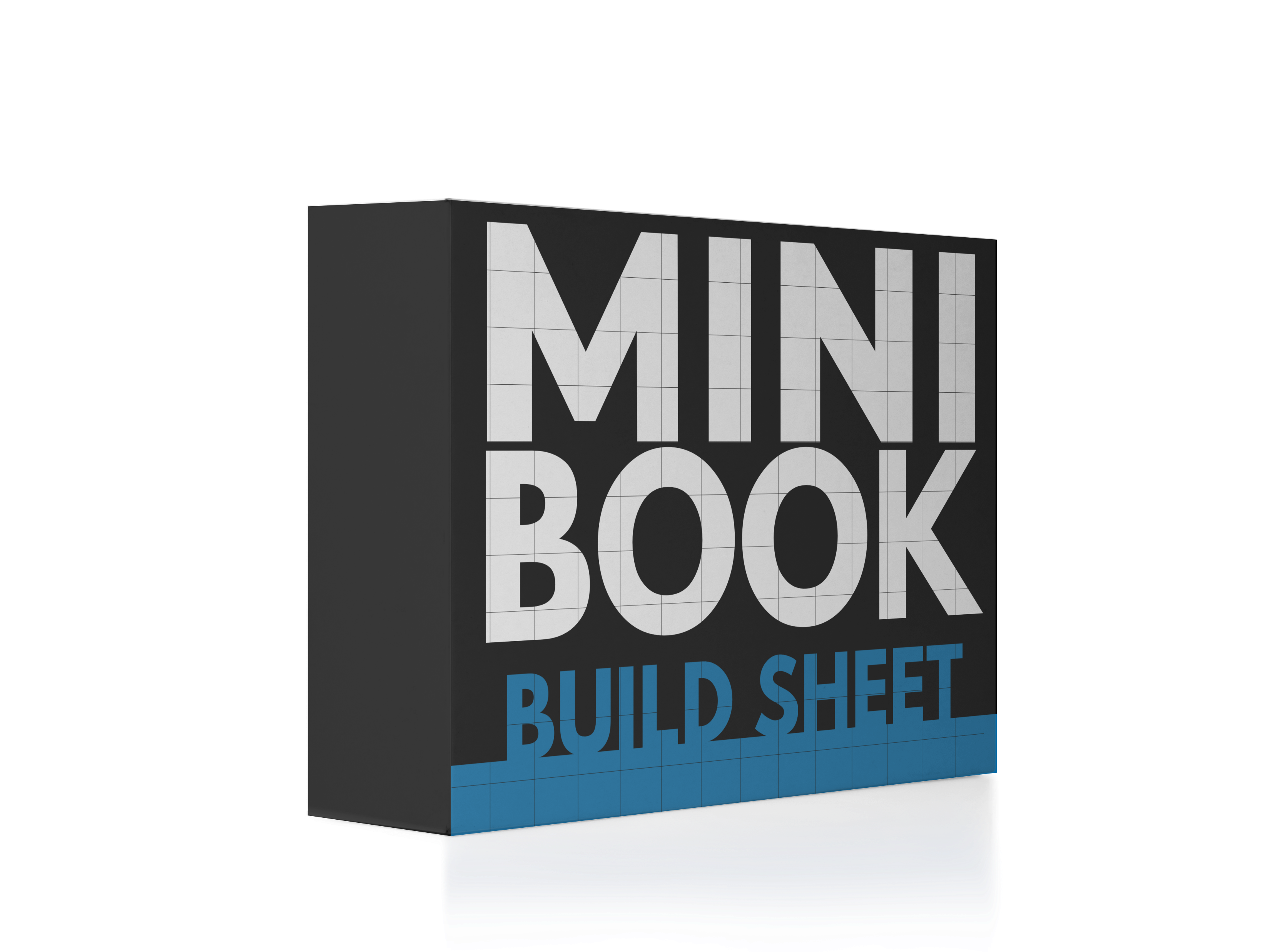
It’s like the ultimate guide to this entire Substack and all my Mini Book books condensed into one living document that manages your entire book project in one spot.
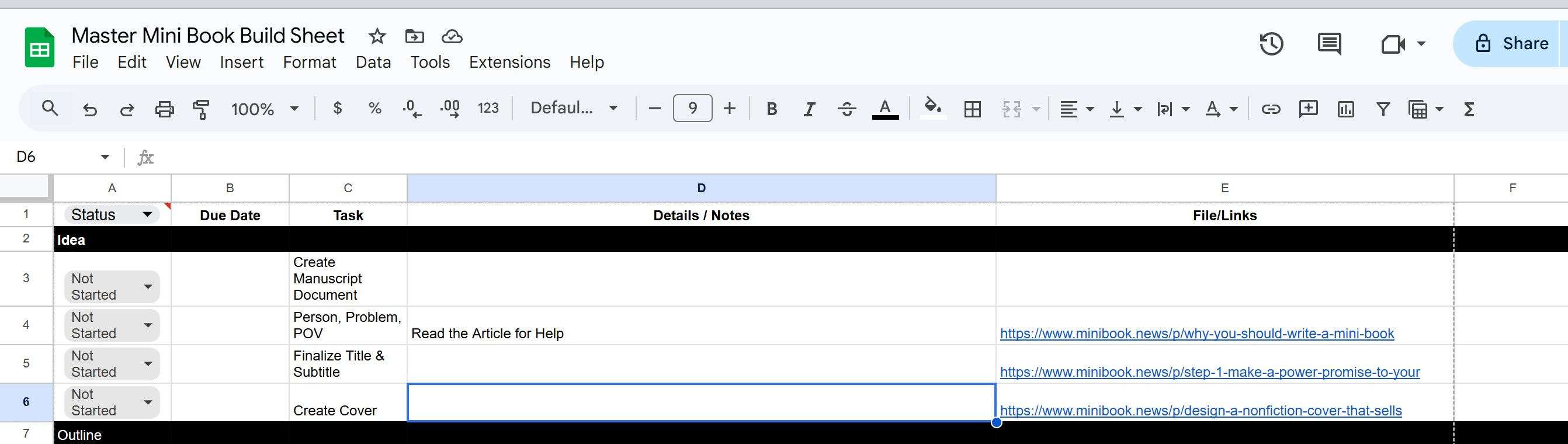
Here’s what’s inside:
The sheet breaks your book journey into 7 phases with 66+ actionable tasks:
Idea Phase - Lock in your person, problem, and POV. Finalize your title and subtitle. Create your cover. Links included to my POWER Promise framework and cover design process.
Outline Phase - Choose your outline style (Sequential, Framework, or 10 Problems). Build your table of contents. Map out 3 main points per chapter with 3 subpoints each. Every task links to the exact chapter in my books that explains how.
Manuscript Draft Phase - Write 10 chapters at roughly 1,000 words each. Add your introduction, conclusion, and lead magnet. Write your “About the Author.” Includes links to my writing process for each piece.
Editing Phase - Clean up your rough draft. Do a developmental edit to make sure the book makes sense as a whole. Line edit for clarity and punch. Proofread for spelling and grammar. Links to my Mini Book Editing Assistant GPT included.
Formatting Phase - Format your manuscript for ebook and print using Atticus or other tools. Add your table of contents, copyright page, and hyperlinks. Review page breaks and margins so nothing awkward happens mid-sentence.
Publishing Phase - Get your ISBN and generate your barcode. Write your back cover text, book description, and choose your keywords and categories that’ll actually help people find your book. Upload to KDP and add A+ content. Every step has a link to my detailed how-to articles.
Marketing Phase - (There’s an Ideas tab for this one—we’ll dive deeper next week)
Each task includes:
A status dropdown (Idea, Not Started, Outline, Manuscript Draft, Editing, Formatting, Publishing) so you always know where you are
Space for your own due dates
Direct links to my articles and book chapters explaining HOW to execute that specific task
Notes sections for your own details, questions, or reminders
Here’s how to use it:
Download the sheet and save it to your Google Drive or open it in Excel.
Start at the top.
Do ONE task.
Update the status.
Move to the next.
That’s the entire system.
Don’t jump around trying to work on cover design while you’re still outlining. Don’t skip ahead to formatting before you’ve finished writing. Don’t try to do five things at once because you’re “being efficient.”
The beauty of this system is it removes decision fatigue. You always know what’s next. You’re never staring at a blank screen wondering “what should I be working on right now?”
When you finish your rough draft, celebrate. I built celebration reminders right into the sheet because writers are terrible at acknowledging wins. Go on a date. Drink something good. Watch the sunset. You just finished a book. That matters.
When you finish editing, celebrate again.
When you hit publish, do something you’ll remember. Take yourself to dinner. Buy something you’ve wanted. Call someone who matters and tell them you did it.
This is a huge moment in your life. Don’t let it pass without marking it.
The hardest part about writing a book isn’t the writing. It’s the overwhelm of not knowing what to do next. It’s the mental load of holding 66 tasks in your head while trying to make progress on all of them.
This sheet solves that.
It’s the same system Category Pirates uses to produce their books. The same system I’ve used to publish 31+ books. The same system that took 9 years of trial and error to build.
And now it’s yours.
There are 66 steps. Focus on the one that’s next. Update the status. Move on.
Keep it this simple and you’ll have a book before you know it.
Paying members can download the sheet at the link below.
Keep reading with a 7-day free trial
Subscribe to The Flywheel to keep reading this post and get 7 days of free access to the full post archives.