

The Difference Between Content and Assets
And why your best work shouldn't live on social

Hey Revenue Writers,
Welcome back to Mini Book Mondays.
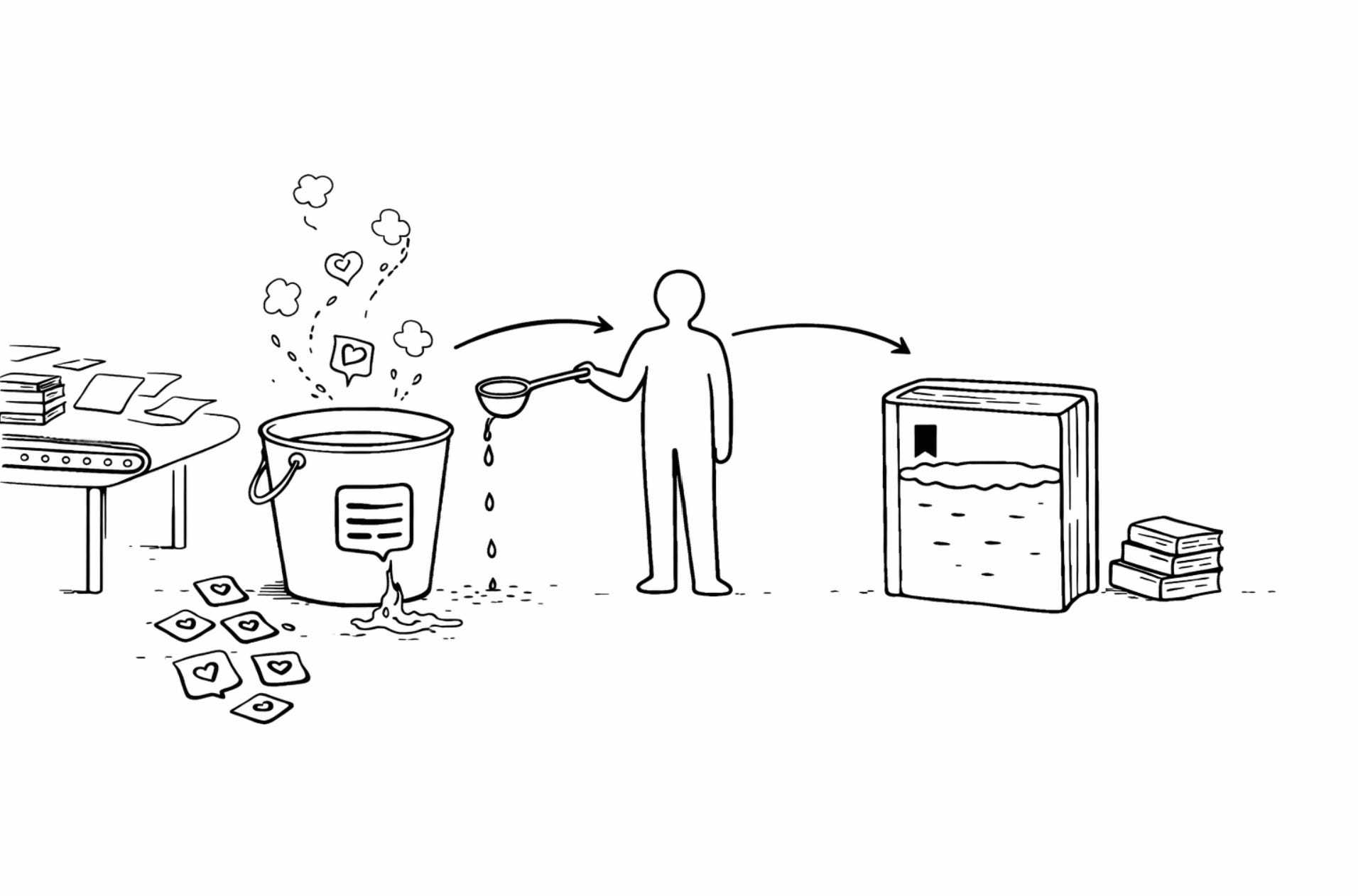
Too often as writers we get suckered into playing the social media game.
We give it all our love, our affection, our thoughts, our best ideas.
Then when the algorithm doesn’t love it or no one notices we feel defeated thinking we should be going viral or it means it isn’t good work.
That’s for the birds.
Social media is designed to be consumed and gone in hours…
Why would we spend the majority of our time on something so fleeting?
It’s a shell game.
Social media is all about chasing and keeping attention.
The platform is designed to make creatives keep their attention on the platform and the ones consuming the content chasing the next post.
This is a lose lose game for Revenue Writers.
Because we never have time or mental energy left to build the assets that grown over time and actually produce income.
That’s why I’m a huge proponent of writing a Mini Book FIRST.
This gives you something that people can check out if they enjoy your social media posts and want to know more.
It also gives you a solid point of view and ability to repurpose content from your book.
Where Should Your Best Work Live?
I pour my energy and writing into two places.
My Mini Books
My newsletter
My Mini Books I publish to Amazon so there are physical and digital copies of it.
This not only gives me a product to sell, but forces me to refine it and care for it to the point where I’m proud to publish it.
I believe if you don’t publish your Mini Book to bookstores… you don’t have a Mini Book, you have a long newsletter.
Because if your Mini BOOK isn’t available where Books are bought and read… do you really have a book?
Plus people respect you more if you’ve gone through the effort to publish your work. Anyone can hit send on an email or publish an article, but it takes time, effort, energy, and intentionality to publish to Amazon or other bookstores.
It signals to others that you believe your work is worth being remembered, verses an article or newsletter typically is lost quickly with the passing of time.
Use Your Newsletter to Rant On and Refine Your Mini Books
You’ll notice my newsletters are 1 of 2 things.
Either a chapter or excerpt from a Mini Book
A spin off rant based on the topic of my writing
You are able to explore more themes, topics, and angles of your POV in your newsletter.
This is a great way to serve your diehards giving them new perspectives without having to wait months or years for your next book.
You can answer questions you get from your Mini Book readers in email because if one person has a question then dozens of other people do as well.
How I Use Social Media to Get Customers
(This is an excerpt from Mini Book Flywheel: How to Design a Category That Makes Your Business Unforgettable)
Mini Book Flywheel
A Mini Book Flywheel is how your book turns into a business.
Here’s how it works:
Core → Content → Conversations → Customers
Let’s break that down, real simple.
1. Core (Your Book)
Everything starts here.
Your Mini Book is the calm center of your business.
If people read your book and don’t know what you’re about, your business is in trouble. If you’re creating content that has nothing to do with your book, your business is in trouble. If your offers don’t connect to the problems you solve in your book…you get it, your business is in trouble.
Everything you do should point back to the book.
Every week’s content, every offer, every idea: ask yourself:
Does this connect to the core idea of my book?
Would someone reading this want to learn more?
Am I making the message clearer or more confusing?
If the answer is “nah,” then it probably doesn’t belong in your business.
This is your anchor point.
Start here. Return here.
2. Content (The Rotation)
Most people treat content like a dice roll.
They wake up and ask, “What should I post today?”
That’s a terrible strategy.
With a Mini Book, you’ve already done the hard work. You’ve got 5, 7, 10 chapters worth of value. That’s your content plan for the next 3 months.
Each chapter becomes a content theme. Each idea becomes a story, a tip, a video, a carousel.
You don’t need to keep creating brand new things. You just need to say the same thing, say it differently, and say it over and over again.
Remember: people don’t need more information. They need reminders.
So stop brainstorming. Start rotating.
3. Conversations (Real People matter more than Views)
This part is where the internet has lied to you.
You don’t need 100k followers. You need 10 people who believe you can help them and are willing to pay you to do it. How does that happen?
Through conversations.
Someone likes your post? Say thanks.
Someone comments? Reply and ask a question.
Someone DMs you? Start a conversation. Don’t pitch, just help.
Someone joins your list? Send them a personal welcome message.
You are not trying to close strangers. You are trying to connect with real people.
That’s how trust is built. And trust is what turns into…
4. Customers (The Result)
This is where the flywheel really takes off.
Someone reads your book. They follow your content. They talk to you. Then, one day…they’re ready.
They reach out. They buy. They join your program, or take your course, or hire you. Whatever path you’ve set up.
And here’s the cool part: their transformation becomes new content.
Their question becomes a new email. Their testimonial becomes a new story. Their win becomes new belief in your system.
And the whole flywheel spins again.
Core → Content → Conversation → Customer → (Back to the) Core
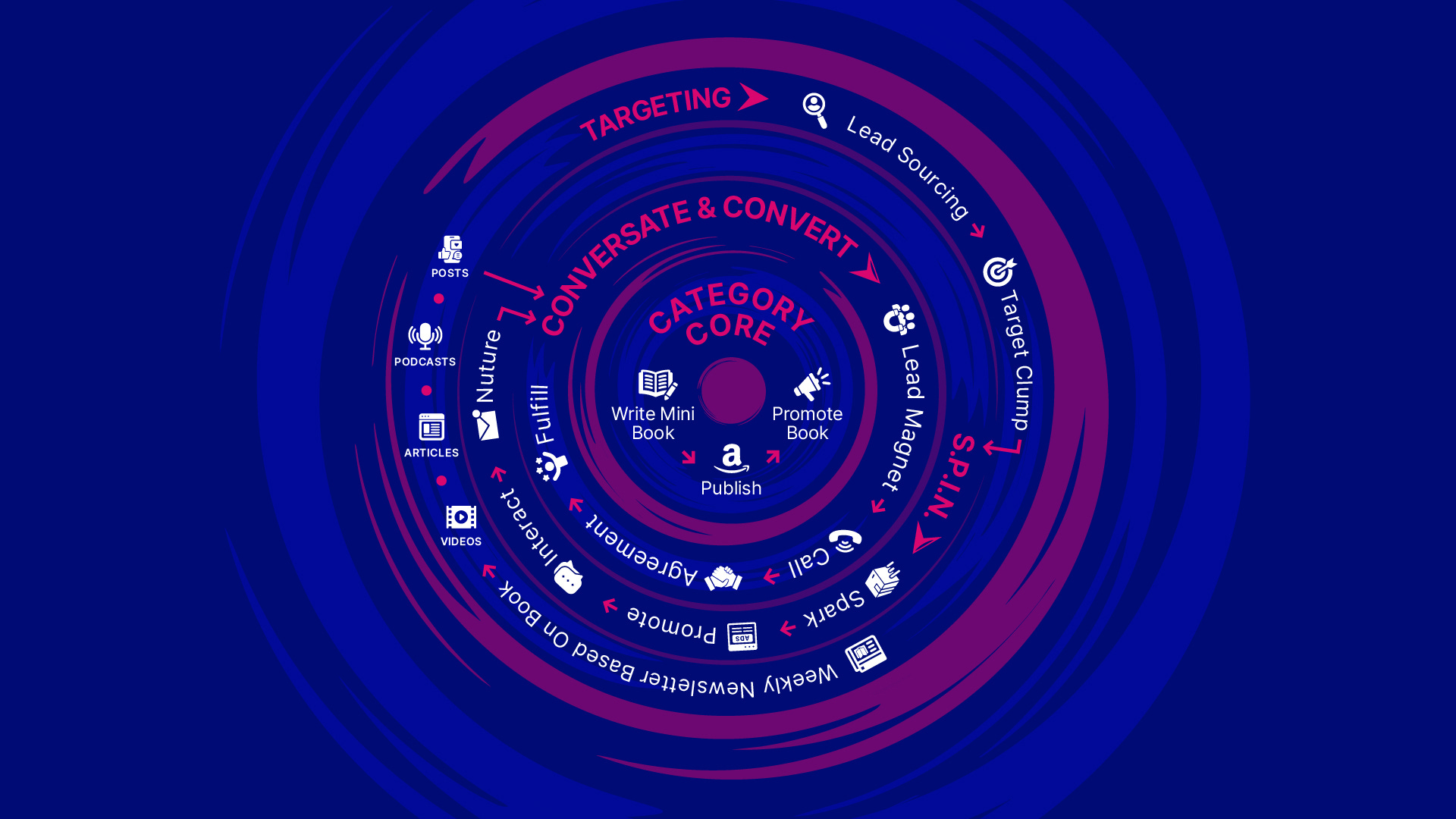
And THAT is how a Mini Book Flywheel actually works.
Most people write a book and let it sit on a shelf (or worse, it never even makes it to Amazon).
Not you.
You’re going to use your book to build a business.
Not because it’s trendy. Not because it’s passive income. But because your book solves a problem people are actually facing.
With a Mini Book powering your Belief Flywheel, your business will be on the path to becoming unforgettable.
The whole point of social media is to be social… said another way. To meet people. That is why I believe in the system I outlined above.
It works.
- Coach Chris Stanley