

The Map Every Author Business Follows (Whether They Know It or Not)

Ever heard a story like this?
Someone tests social post after social post, month after month, maybe year after year. Not anchored to anything in particular. Just throwing things out there to see what sticks.
Then something hits.
They’re not even sure why.
Comments flooding in, DMs stacking up, strangers begging to give them money. And they’ve got nothing to send them.
No book.
No offer.
No product.
No core to catch all that attention and turn it into something real.
Just a lame “Follow me and be sure to hit the bell icon to get notified.”
They don’t have a business that spins around that post... so it dies off.
That’s what happens when you build backwards... you chase virality before you build the vehicle.
I want to talk about the map that proves it.
Over the past few months I’ve been somewhat obsessing about the concept of Flywheels.
Last year I wrote a book called Mini Book Flywheel and that is part of why my brain keeps thinking on it. Mini Book Flywheel was my first attempt at explaining how businesses are like Flywheels and how a Mini Book is one of the most powerful ways to spin it.
But like many of my books it was just as much exploration/revelation as it was explanation.
So I had much more I had to sift through.
Let’s dive into this map I keep seeing.
I call it the Company Flywheel.
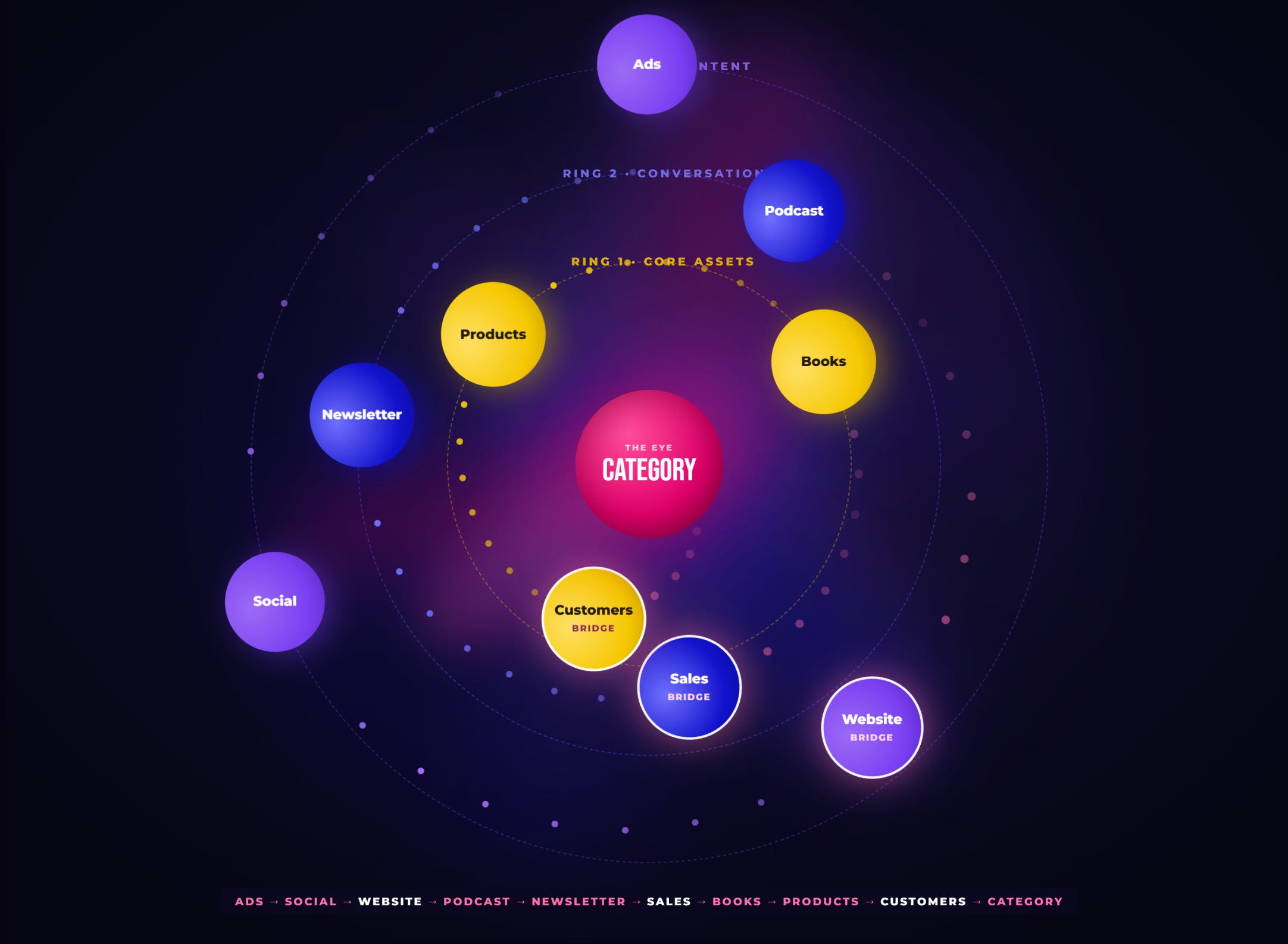
Company Flywheel
A company flywheel is different from the “Content Flywheel“ I discussed last week.
Think of the two flywheels as different views.
Content Flywheel is for weekly content planning. While the Company Flywheel is more for big picture strategy for your company.
CORE - Category
Like all flywheel frameworks I can’t shake the reality that at the core is your Category.
If you are a Mexican gourmet chef so much of what is thought about you is pre-determined by the type of food you are cooking.
If someone walks into a “Mexican” restaurant we expect certain things... mainly margaritas on the menu and free chips and salsa.
You are boxed in, good and bad.
You change the category, “I am a pastry chef.” Well the category changed and everything changes.
The same goes for us as authors in our own business.
If you write about Sales Funnels... you are going to be lumped in to the Funnel Bro’s crowd and inevitably compared to Russell Brunson because he is the category king of funnels.
So our author business is VASTLY determined by what category of book/business we decide to write.
If you write about how to have great hair... might be a tough sell to sell baseball caps or accounting services.
Your category locks you in.
CORE ASSETS - Ring 1
Once you’ve decided on your category of business and book you have to now create your core assets.
1. Books
2. Products
3. Customers
Without those 3 things it becomes really tough to make your flywheel spin.
Books
The book is your category in tangible form.
It is your Bible... there is hardly a category of religion called Christianity without a Bible.
Your book does the same thing. It evangelizes your category. It spreads your vision and mission.
It puts you as a leader of the category simply by having written the ‘book on it’.
A book also happens to be one of the easiest to promote and transfer from person to person.
“Want to know how to save on Taxes? Here you go.” And you hand them your book. Instant answers if they want them.
A Substack post, a newsletter, a Youtube video is less permanent. It’s more like a newspaper article. Sure it gets catalogued and does last some time in history, but its nothing like the Bible or Homer’s Odyssey. Books that were passed on verbally then written down onto papyrus, paper, and eventually the printing press.
Your book is the greatest evangelizing asset at pulling people deeper into your core.
Products
Often I’ve had people read my book, Independent Adjuster’s Playbook, and throw down thousands of dollars to hire me as an adjusting mentor.
They go to my website click the product and buy.
But if I didn’t have the product I’d never get them to be a customer.
You have to have products beyond your book to have a business with a spinning flywheel.
I wrote extensively about the different ways Mini Book authors can do this in Mini Book Money, so I won’t beat the horse too much.
But my 3 favorite products are,
- Coaching (1 on 1)
- Cohorts (1 to some)
- Courses (1 to masses)
Typically you start with some form of coaching, whether its a done for you, done with you, or DIY advice.
It’s much easier to pull someone from a book into a 1 on 1 relationship than dump them into a digital product.
As AI makes creating digital easier and easier the human element of 1 on 1 human interaction will continue to be valued more and more.
So don’t snub your nose at 1 on 1.
Customers
Every thriving business flywheel must have raving superconsumers, AKA customers that love the product and company so much they’ll advocate for it.
You can go very far in business just based on word of mouth.
But you can’t get word of mouth without finding them and evangelizing them (usually with a book) and getting them to become paying customers through products.
I had someone reach out this week telling me “Someone came and looked at my wrecked car and I asked them how I could learn to do what they did. They referred me to you.”
Turns out someone who paid me $5k to have me mentor them then turned around told a potentially competitor in their market that I was the way to get started...
We have no referral program, no commission, just happy customers referring people who they think we can help over to us.
That’s the flywheel core spinning around the category you operate in.
CONVERSATIONS - Ring 2
Before someone reads a book or buys a product to become a customer they almost always encounter you and your category through a conversation.
I talked some about this last week when I dove into the Content Flywheel.
This ring is about engaging with people that have found your category and your content (Ring 3) and want to know more.
Typically we engage with them in 1 of 3 ways.
1. Sales (DM’s, Calls, Meetings, Webinar)
2. Newsletter (Email/Substack/etc.)
3. Podcast (audio/video)
These are the ways we get someone to raise their hand. This isn’t pieces of content, this is company tools to product content and opportunities to talk to people.
So yes some overlap from a “Podcast episode” that is spun up from a “newsletter article” but in a company CEO viewpoint we say, “How is the newsletter performing?” We aren’t asking about one issue, we are saying how is the company platform of the newsletter going.
What that really means is “How many people are we having actual conversations with?”
Whether its your newsletter, podcast, or sales conversations these platforms provide us ways to get people to “buy a book” to learn more.
Or to purchase product we introduce to them so they can become customers.
CONTENT - Ring 3
This is where most new business owners start, content.
Which makes sense. It is what we notice FIRST about a business. But starting with content before you have the category, your core, and your conversations figured out is just plain backwards.
Your content is purposeless, aimless, and often worthless if you don’t have a category you are pointing people towards.
What is it they are looking for? What are you helping them solve? What is your unique POV of how they can solve it?
All of these things are your category and content without a category is noise.
Social
Your social media channels are there to find new people to have conversations with.
Every post carries your category, your POV, your fingerprints on it. People who like what they hear want to engage more. They join your newsletter, listen to your podcast, DM your or sign up to get on a call.
This isn’t just about posting anything its about being strategic, knowing what the next steps you want an interested browser to do with your company.
Ads
Targeting people directly isn’t simply “social content” it is advertising.
Advertising can be effective at showing the masses your POV whether its your book, podcast, lead magnet for getting on your newsletter, or a direct outreach to DM, to try and get them to have a conversation with you.
But most times social and ads are ultimately directing them to a place that you own... your webpage.
Website
Your website hosts your lead magnet, a call scheduler or something that brings people into a conversation with you.
You’ve moved them from the rented land of social media into your domain. (literally) It is so important to have this as a bridge, even if it isn’t a massive wordpress site, but just a lead magnet page through your email provider. This is your way to know that someone has gone from the outer ring to enter into a conversation with you.
The Bridges
Here’s what I couldn’t unsee once I saw it.
Each ring has a bridge... the one asset that hands a person to the next ring inward.
Website bridges Content -> Conversations.
Sales bridges Conversations -> Core Assets.
Customers bridge your Core Assets -> Category through word of mouth.
Belief doesn’t leap from the outer edge to the core. It spirals inward, one bridge at a time.
We often focus on one piece, but don’t pay enough attention to if we have all the pieces in place and most importantly if someone can even walk across the bridge.
Hope that helps you map out your author business and how to improve it.
Keep spinning,
Coach Chris