

The messy backend of building a business that nobody explains... solved.
The 3 Layers of a Flywheel That Builds Your Business

Hey Revenue Writers,
Every business needs a system that finds customers, brings them into your orbit, and solidifies you as the right product.
Most people think of this process as sales funnels.
Usually goes something like this.
→ Awareness → Interest → Decision → Contact → Sell
or
→ Social Media → Lead Magnet → Sales Page → Order Bump → Upsell → Downsell
You get the idea. But here is a graphic to make sure you feel how crazy it can feel.
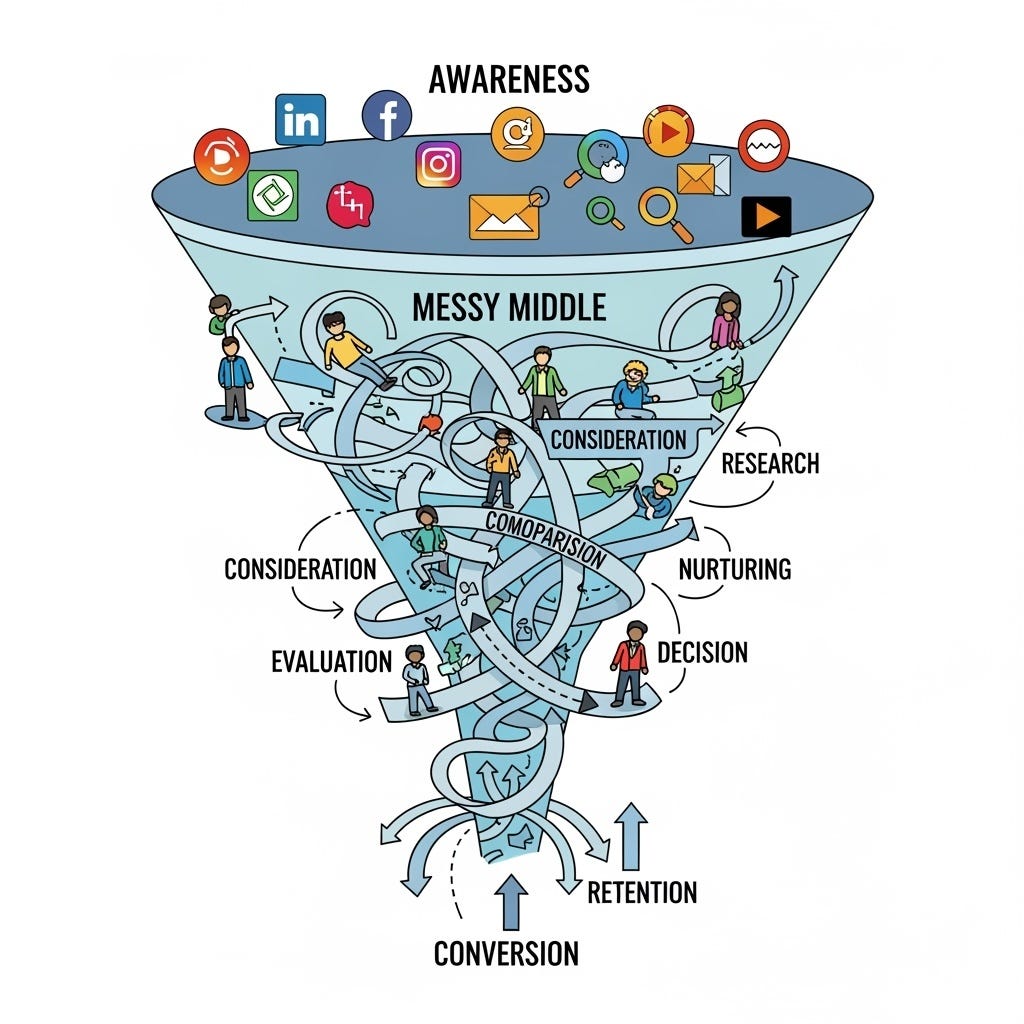
This shows the two extremes I see funnels take.
Over simplification (it never feels that clean and straightlined)
Over complication (see all that swirling going on inside the image?)
Sales funnels always felt like I was missing a piece of the puzzel.
I learned sales funnels from Russell Brunson. Best in the biz at funnels. But I never could make sense of how his whole ecosystem worked with his funnels. I understood sales page funnels but then people got dumped into something he never could explain.
The messy backend of swirling nonsense.
So I started looking at my own business and how ti worked.
Rarely was it → Lead Magnet → Sales Page → Sale.
It was months or years from someone raising their hand as interested to spending $$$ with me. When they spent they’d jump straight to the $5000 package.
So sales funnels don’t fully explain how that works. That always bugged me.
Slowly I began to realize a funnel is for a single moment in time, or a compressed moment in time. It’s the checkout process.
But the messy backend? The ambiguous blog that actually made Russell Brunson and so many online marketers successful wasn’t the checkout page of their sales funnel.
It was their flywheel.
While a funnel looks and acts like a tornado, it spins up fast, pulls people in, spits them out, bada bing, bada boom.
Flywheels are like hurricanes. Still pulling people in, but at a much slower speed. In nature hurricanes last 10x longer than tornadoes so this is the weather system, the business ecosystem that drives our businesses.
But I wanted to explain it clearer than I ever had.
It’s the invisible force behind the drawing of your customers into orbit around you and keeping them in orbit around you until they are ready to buy.
Having been running an online business for 10+ years I try really hard to simplify everything… for me.
Because I get overwhelmed if my white board or notebook gets too complicated.
Today I want to peel back what makes a flywheel spin and what the layers of the flywheel is actually made up to make it practically to you and your business.
3 Layers of a Business Flywheel
I wrote a book called “Mini Book Flywheel: How to Design a Category That Makes Your Business Unforgettable” and in there I break down a flywheel, but it was still too complicated. (see below, I was so close, yet so far)
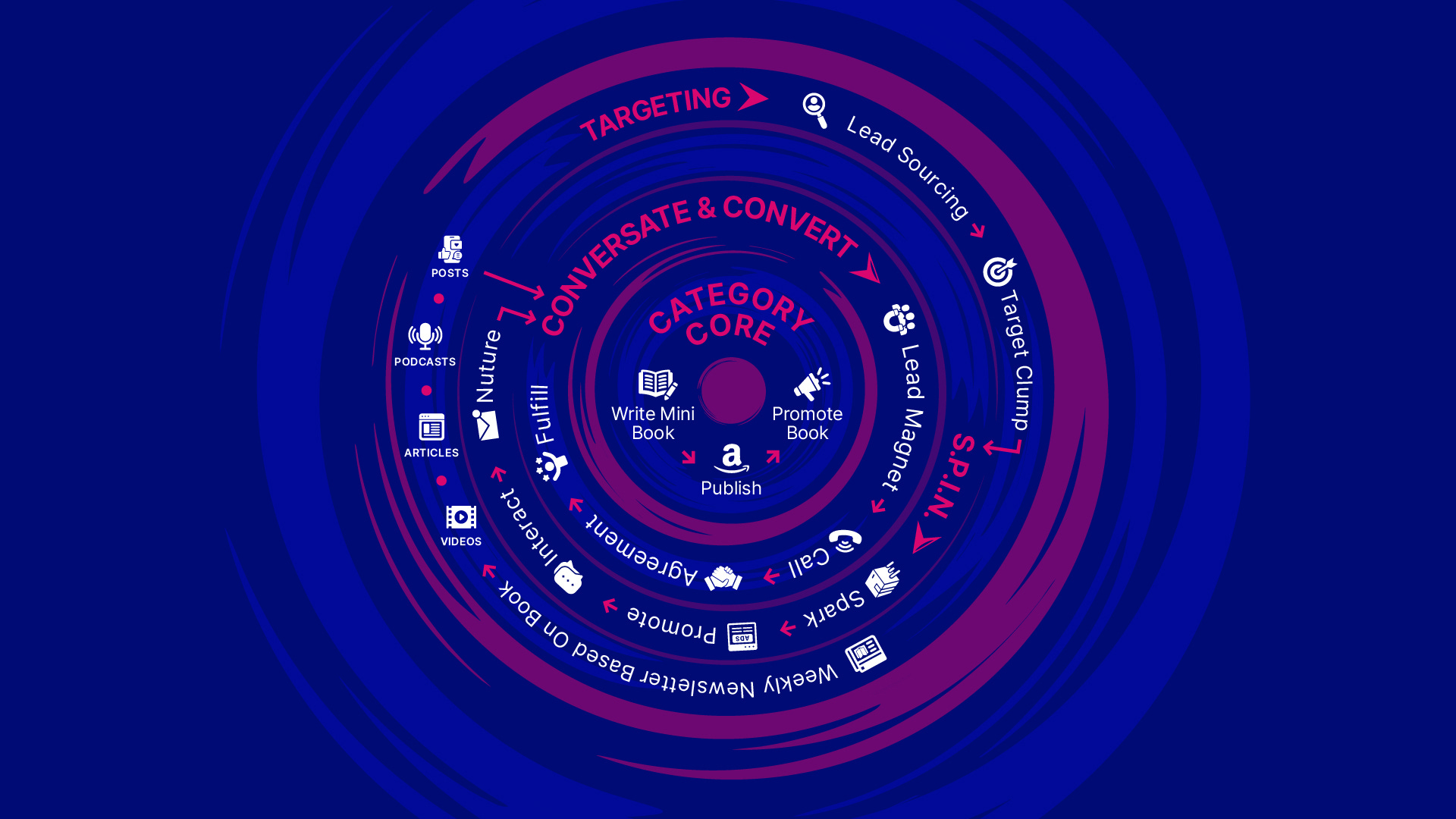
This past week I’ve started building Flywheel Publishing, the first flywheel builder that I know of.
While building it I had an epiphany… basically a re-realization and an idea for simplification.
There are 3 layers to a flywheel.
Category
Conversations
Content
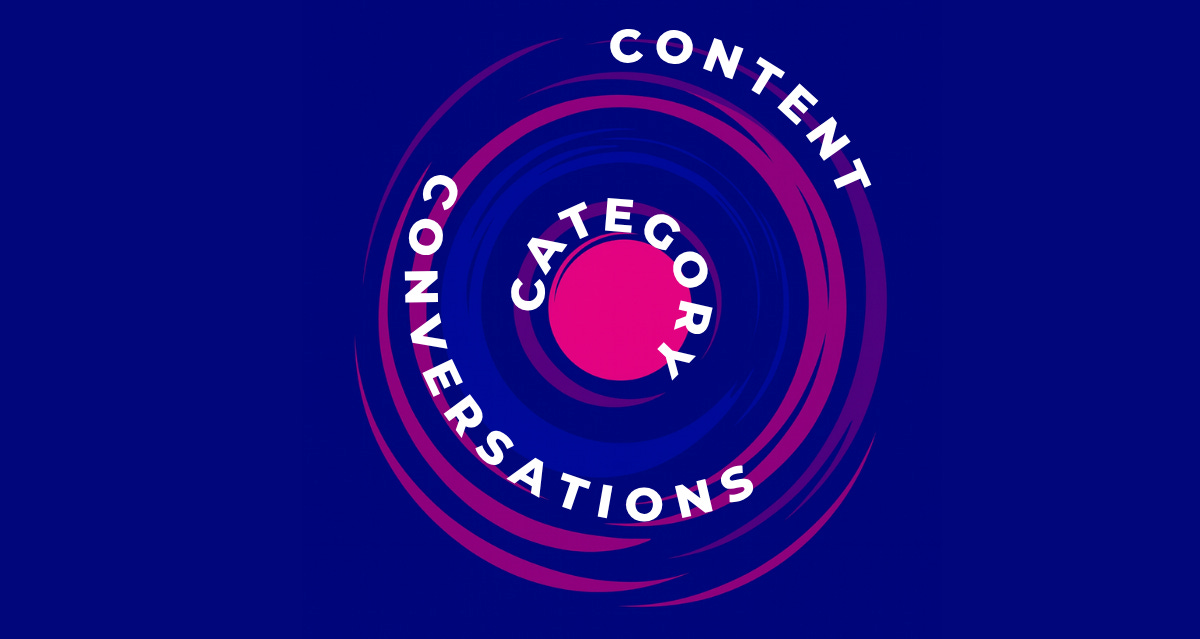
Ahhh much simpler and they are all “C’s” so, that makes me happy.
Let’s look at these 3 layers quickly.
For those that read Mini Book Writing or Mini Book Model you’ll know I like to break things down into 3 points and 3 subpoints.
So yes, the 3 layers are my points and now they’ll each have 3 subpoints. (this is a very meta teaching moment)
Category
When building your category there are only 3 things you have to do. (only being very tongue and cheek)
Name your category
Frame your category
Claim your category
Claim Your Category
This is the basis for your Flywheel.
Ryan Levesque calls it being a Category of 1.
Even if you don’t invent the next Uber category, you still need unique positioning, a way for people to understand what category you sit in.
Being intentional about this is so important.
I’m not a self publishing guy. I was the Mini Book guy
I wasn’t an insurance instructor. I was the auto guy.
So first you have to name what category you belong to. This is know as languaging and its harder than it sounds.
I’ve spun and spun and spun around the idea of mini books, smart publishing, category publishing… then WHAM… flywheel publishing hit me.
There is a lot to languaging a category but one you have named your category you can begin to…
Frame Your Category
Think of this are you core framework.
Uber set the stage of how ridesharing worked. Users have an app, they request a ride, it looks like this. The drivers get set up like this. They get a notification. blah blah blah.
The blueprint for the category the framework of how it all worked was decided and now you can’t imagine a ridesharing app looking or working any other way.
As authors we do this through written frameworks (like the one I’m diong right now). I’m framing what an author flywheel is made up of.
That’s me framing the category of an author flywheel.
Claim Your Category
Claiming your category is becoming known as the king or queen of it. (according to Category Pirates 🏴☠️ it often results in earning up to 76% of the market share)
My favorite way to stake a claim is with a… mini book.
5000 - 15,000 words that define your category and show you have expertise in it.
Then the rest of what I’ll lay out moving forward is the process of continually “claiming” your category.
Conversations
Once your category starts spinning you will start off first with direct conversations with people.
This could be,
DM (direct message)
Sales calls
Newsletter emails
Events
etc.
This is how you get moving in the early days.
When you want to go to the masses to find more people to have conversations you move to layer 3.
Content
This is what most people think about when they want to get their flywheel spinning.
Content.
Social Media Posts
Blog Posts
Podcasts
Video
Website
etc.
But if you start with content you are missing the big opportunity!
Why Category → Conversations → Content is the Right Order
Your category and the problem it solves fuels your conversations and makes you attack the problem for people you want to serve.
That inspires conversations and shows people you care.
Those conversations bring up questions which spins up valuable content ideas.
When you follow this pattern growing your business gets so much easier.
Can’t wait to hear your feedback
Coach Chris