Why You'll Feel Like a Failure Two Weeks After Launch (And What to Do Instead)
Final Chapter of LAZY Book Launch Model

Hey Revenue Writers,
We’re on the home stretch of the LAZY Book Launch Model.
So far, we’ve covered:
Launch Lunacy: Why Traditional Book Marketing Is Broken
L - Leverage an Email List - How your weekly emails become 52 sales opportunities
A - Amazon Page Optimization - Why clarity beats cleverness (and my $1,000 mistake)
Z - Zero in With Targeted Ads - The 5-5-5 Method that finds your winning headline for $75
Now we’re at Y - Year-Long Launch. The chapter nobody wants to hear but everyone needs.
Because here’s the truth: two weeks after launch, you’re going to feel like a failure. Even if you hit bestseller. Even if you got reviews. I’ve launched 30+ books and felt it every single time.
This chapter is about why that feeling is lying to you and what to do instead.
Also I’m thinking about doing a workshop on LAZY Book Marketing. But if there’s something else you’d rather dive deep on, let me know.
Take the poll and let me know.
Let’s get into it.
—Chris
Y - Year Long Launch
Two weeks after launch, you’ll feel like a failure.
I know because I’ve been there thirty times. Hit bestseller. Got reviews. Made sales. Still felt disappointed. Even when I hit my goals, I felt frustrated. There’s always this unspoken expectation that the book will change everything immediately.
It doesn’t work that way.
Most self-published authors never sell 200 books in their book’s entire life. Not because their book is bad. Because they stop talking about it. They do one big launch, burn out, and move on. The book sits there. Dead.
That’s not LAZY. That’s quitting.
The year-long launch fixes this. You stop measuring in days and start measuring in years. You stop sprinting and start showing up weekly. You stop expecting instant transformation and start trusting the process.
Here’s how.
Think in Years, Not Days
Launch Lunacy measures success in days. The 7-day launch. The 30-day campaign. Hit your spike and pray it sticks.
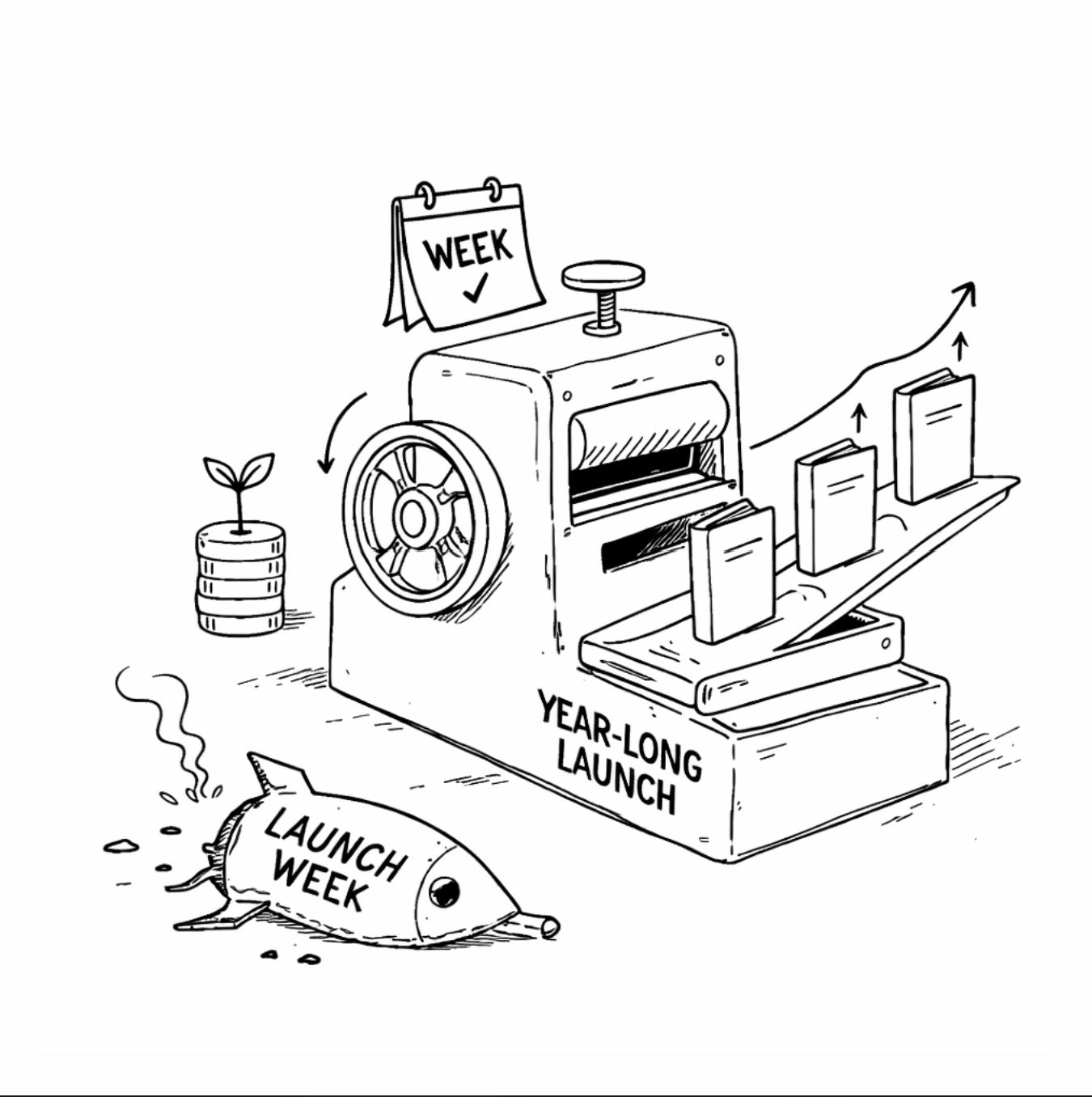
That’s not how books work. Books are long-term assets. They appreciate or depreciate over time based on how you treat them. A book you invest in for a year becomes more valuable. A book you abandon after launch week becomes rusted, busted, and dusty.
The year-long launch is how you turn your book into a business asset, not a forgotten file.
The 200 Book Threshold
Most self-published authors never sell 200 books in their book’s life.
They stop talking about their book. Whether they did Launch Lunacy or a silent launch, authors become the quietest person about their book. You should be your readers’ greatest advocate for solving the problem your book helped you solve.
The only way to help someone solve that problem is if they read your book.
200 books becomes our new metric.
If you followed the LAZY method, you may have sold close to 200 from pre-order and launch week alone. If you didn’t, use it as your first marketing goal. You have 1 year to make sure your book sells at least 200 copies. When you do, you move onto bigger goals like 1,000 books sold.
One year. 200 books. That’s the starting line, not the finish line.
Your Book Is a Business Asset
Many authors think of their book as a product. A revenue stream.
Your book is a business-building tool. Like a large piece of machinery, it can be expensive to purchase and maintain. But your book, done right, does the heavy lifting for you.
Like a business asset, your book can depreciate or appreciate over time.
How you treat that book determines whether it becomes more valuable or less valuable. If you invest into it, it brings you dividends for years. If you don’t, it becomes rusted, busted, and dusty.
That’s why the year-long launch is so important. You invest into it for a year to make sure you not only get a return on your investment but appreciate the value over time.
This is a legacy, not a launch.
Measure in Years, Not Days
9 years ago I wrote the Independent Adjuster’s Playbook.
I did a launch and it was great. But the best part? I’ve never stopped promoting that book or the message in that book. It has been the engine of my business since I wrote it.
That’s what you want. Not a rusted forgotten piece of machinery.
A book is a legacy. It lasts longer than social media posts or YouTube videos. It compounds over years, not days.
Books matter because they last.
Stay Visible Weekly
Your audience will forget which book you wrote. They’ll forget to read it, even if they bought it.
This is why the year-long launch works. You show up weekly. Same email. Same audience. One extra line in the P.S. That’s it. No new campaign. No new content. Just the email you’re already writing.
Constant contact keeps you remembered.
The Weekly P.S. Strategy
You will be sick of writing about your book long before your audience is.
Just like I highlighted in the Leverage Email chapter, email once a week and mention your book in the P.S. Keep writing about the same problem you wrote about in the book. You solved it and documented it for yourself, but everyone else is still fighting that same problem.
Keep telling them how to beat it.
I know good friends who purchased my book and forgot to read it. Years later they’re like “Why didn’t you tell me to read this book!?!” Obviously I did. That’s why they owned it.
One line. 52 times a year. That’s the strategy.
Reviews Compound Over Time
I don’t get a ton of reviews right out of the gate.
Because I don’t do Launch Lunacy and beta readers, I don’t get those early reviews. But I do keep getting reviews for months and years. I’ll never forget looking at the Mini Book Model listing and seeing over 80 reviews.
I hadn’t looked in almost a year. It was at 15 the time before that.
You have to stay consistent to get reviews.
It takes people time to finish your book and remember to review it. Asking someone to review your book doesn’t have to be some sleazy thing. If someone mentions that your book helped them, ask them to leave a review.
Over the year, your reviews keep going up.
Transformation Takes Time
The most important thing we forget during launches is it isn’t about the book.
The book is only a tool to help others achieve a transformation we experienced ourselves. That transformation takes a while and compounds over time. Someone reading your book today may not experience the total transformation for months or years.
This is why the year-long launch works. You give people time to change.
The 6-Month Gap
The real results don’t show up for 6 months.
Think about someone who buys your book on launch day. A month later they remember and finish your book. They apply your 90-day roadmap and get some early wins. Months later those wins compound into a whole change of life.
That is the 6-month gap.
I see this in my IA Path business. Insurance adjusters buy my book. Follow the 8 steps. 6 months to a year later they’re back to buy my program.
Change is slow. Transformation takes time.
Transformation = Trust
Stuart reached out, pivoting for the 2nd time.
I’d helped him write his book about project management. He wasn’t seeing many leads come in, so he felt the book wasn’t working for lead flow 30 days after his book launched. 6 months later, as we were wrapping up his 2nd book, he said, “It’s ironic we’re working on this new book and the old book’s funnel just took off.”
Now he’s scaling using the same book he declared didn’t produce leads.
Once that transformation happens, you get customers.
People trust those who have helped them. If your book transforms one aspect of their life, many will want to get an even bigger transformation with your help. This is why your book is an appreciating asset.
For 1 year you’re just pushing people to the book and seeing what pops out.
The LAZY Year-Long Launch in Action
Just do the LAZY method whenever you want to push your book.
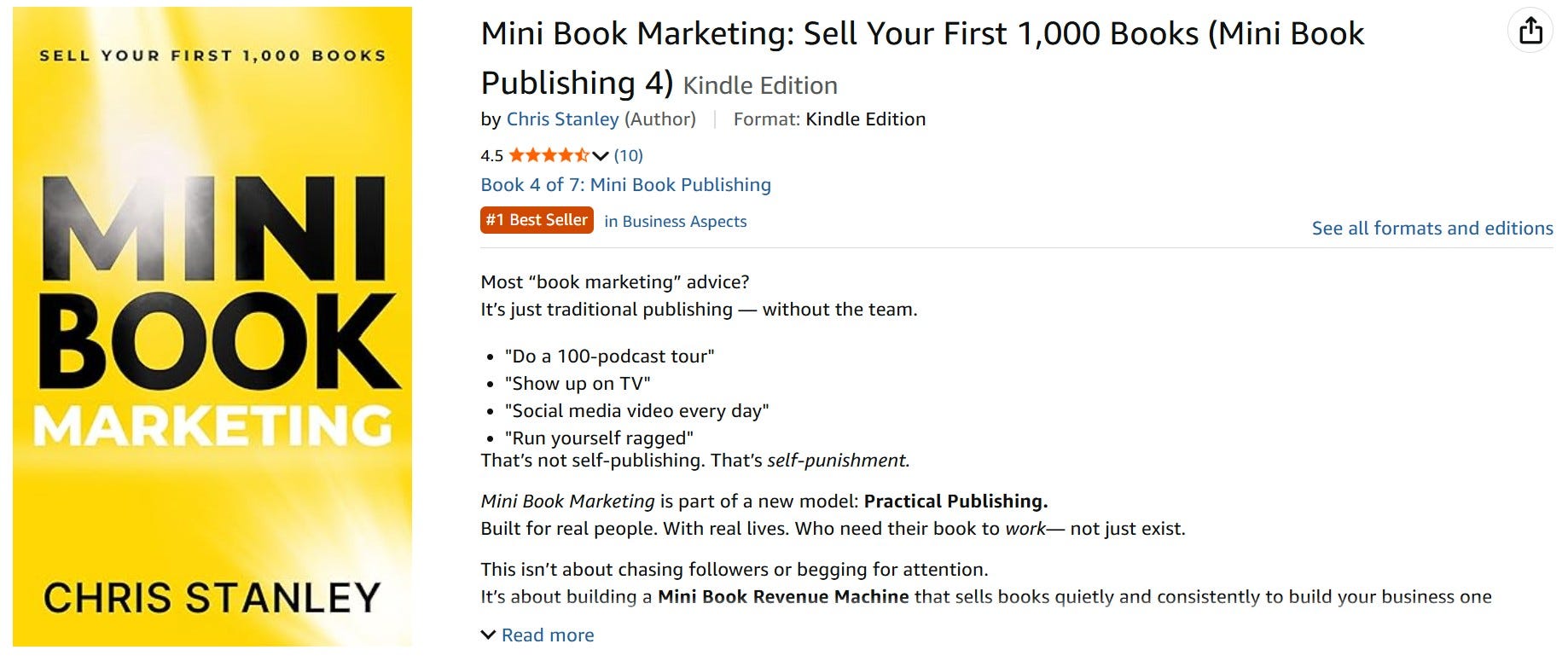
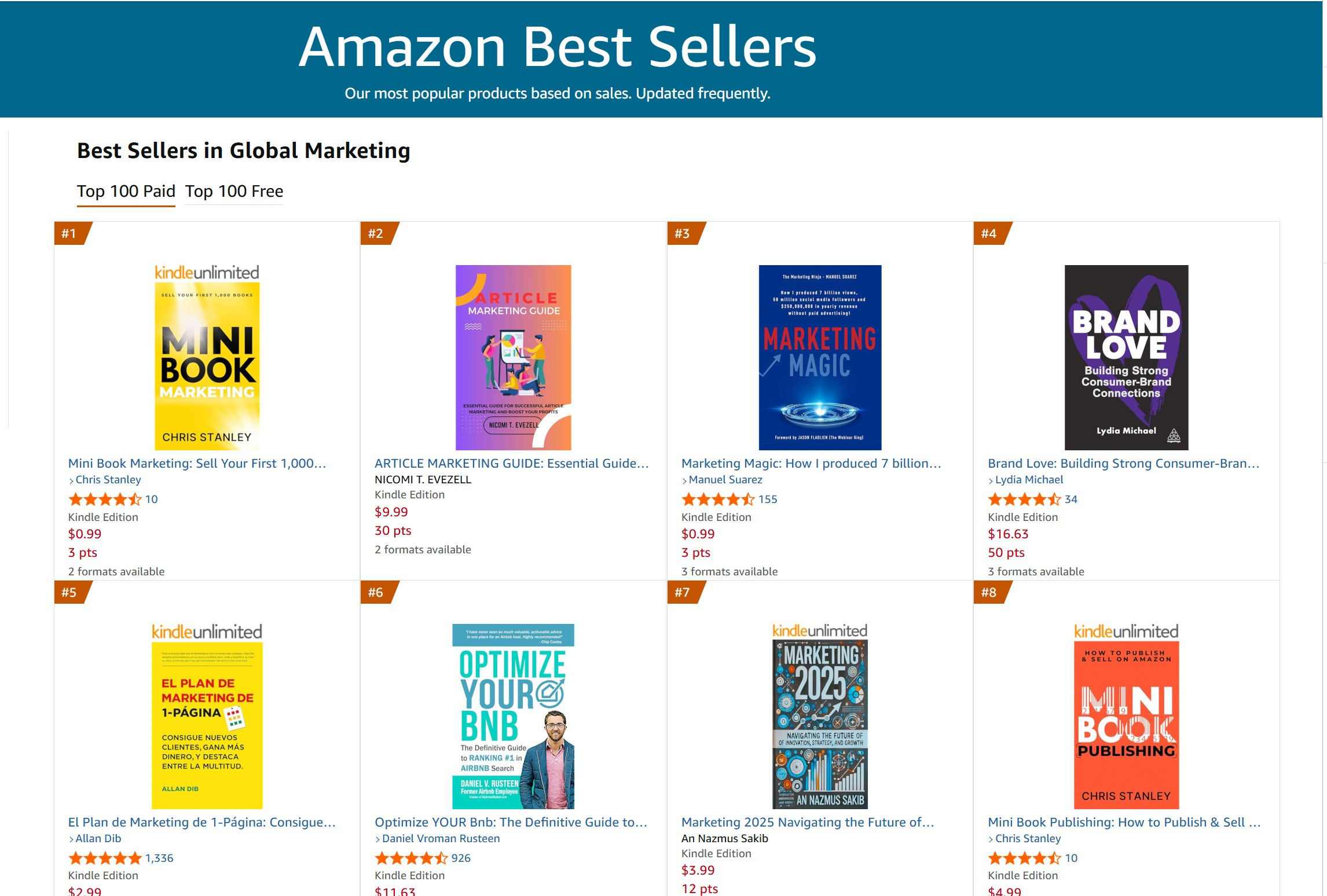
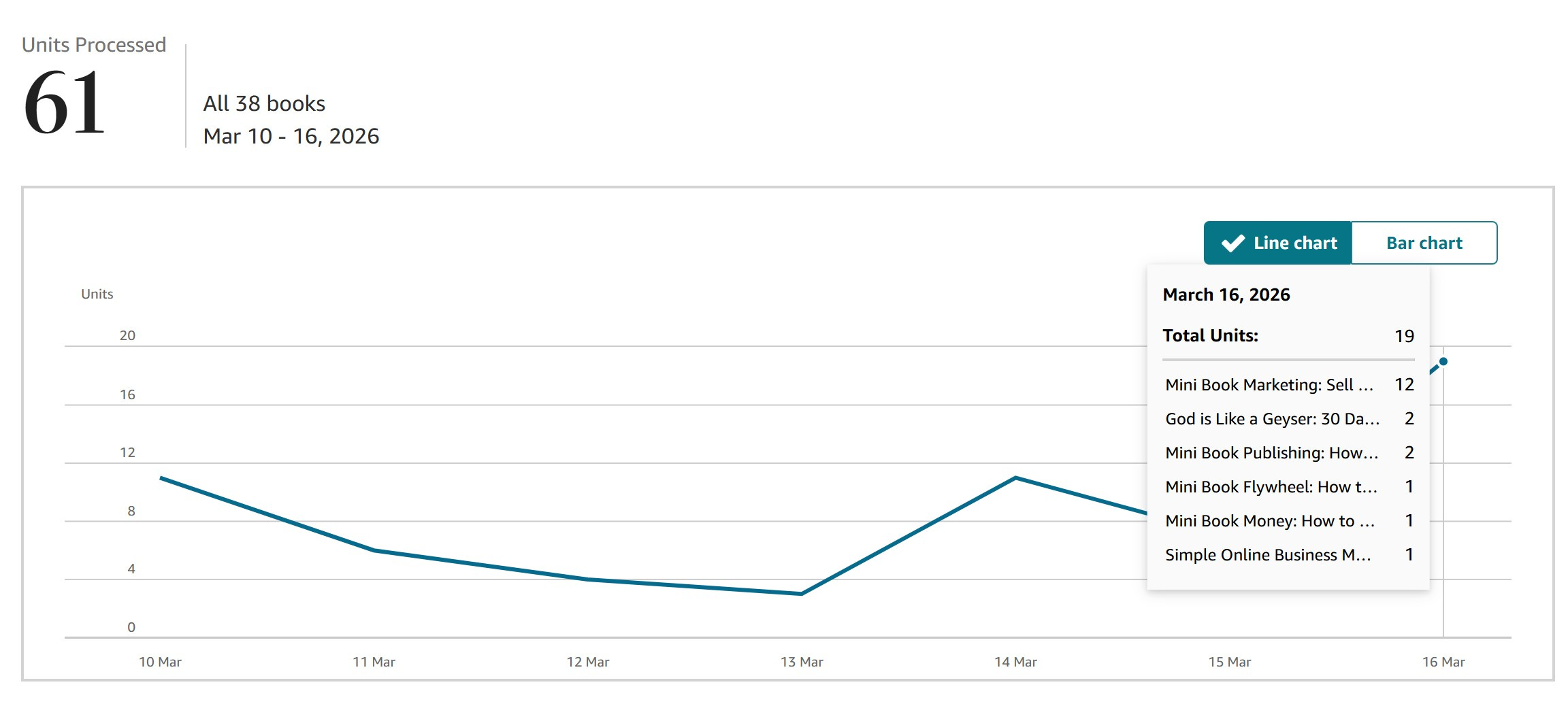
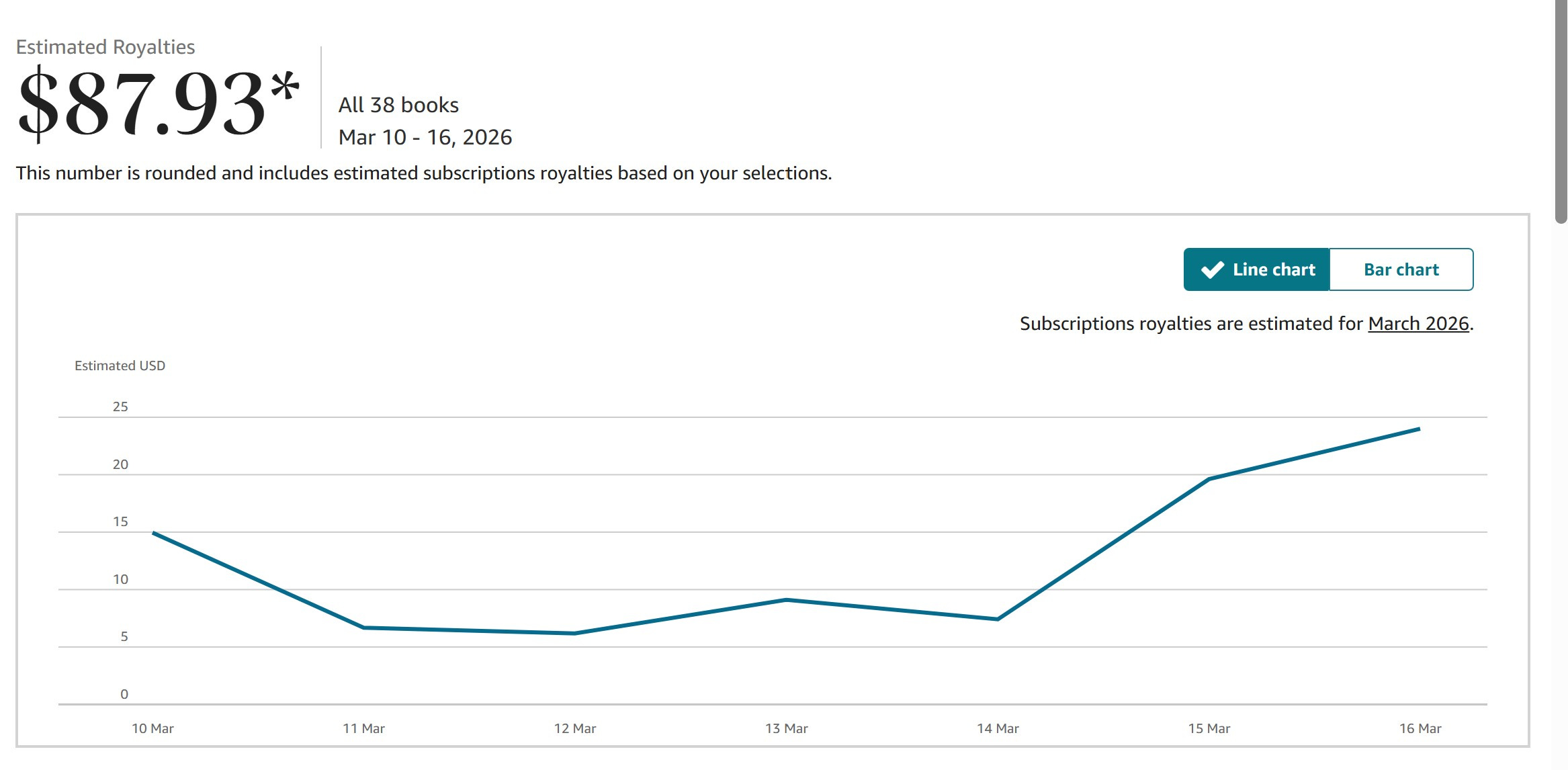
As I was writing these chapters, I spun up a new push for Mini Book Marketing. Dropped the price to $0.99 and ran my proven BookBub ads with a new headline.
Below are the results I got for a book that’s been out for 8 months.
Dates Run: March 10-16, 2026 Bestseller: March 11-17, 2026 Ad Spend: $130.00 Royalties: $87.93 Net: -$42.07 Books Sold: 49 (Total in Series) Target Book Sold: 30 Average Target Per Day: 5 Cost to Acquire Customer: $0.85
Big caveat here: I know it isn’t fun to lose money to get customers. But if I sell one other book to each of these readers, I break even on acquiring them. Getting a reader and potential customer for under $1 is a steal to me.
I’ll keep running these ads as long as I have money.
This keeps me at #1 and getting new people into my series and business. That’s the year-long launch. Not one big campaign. Just showing up when you want to push and using the same LAZY method every time.
One year. 52 P.S. lines. Occasional ad pushes when you want a spike.
That’s how books become business assets.